
A Price Before They Commit
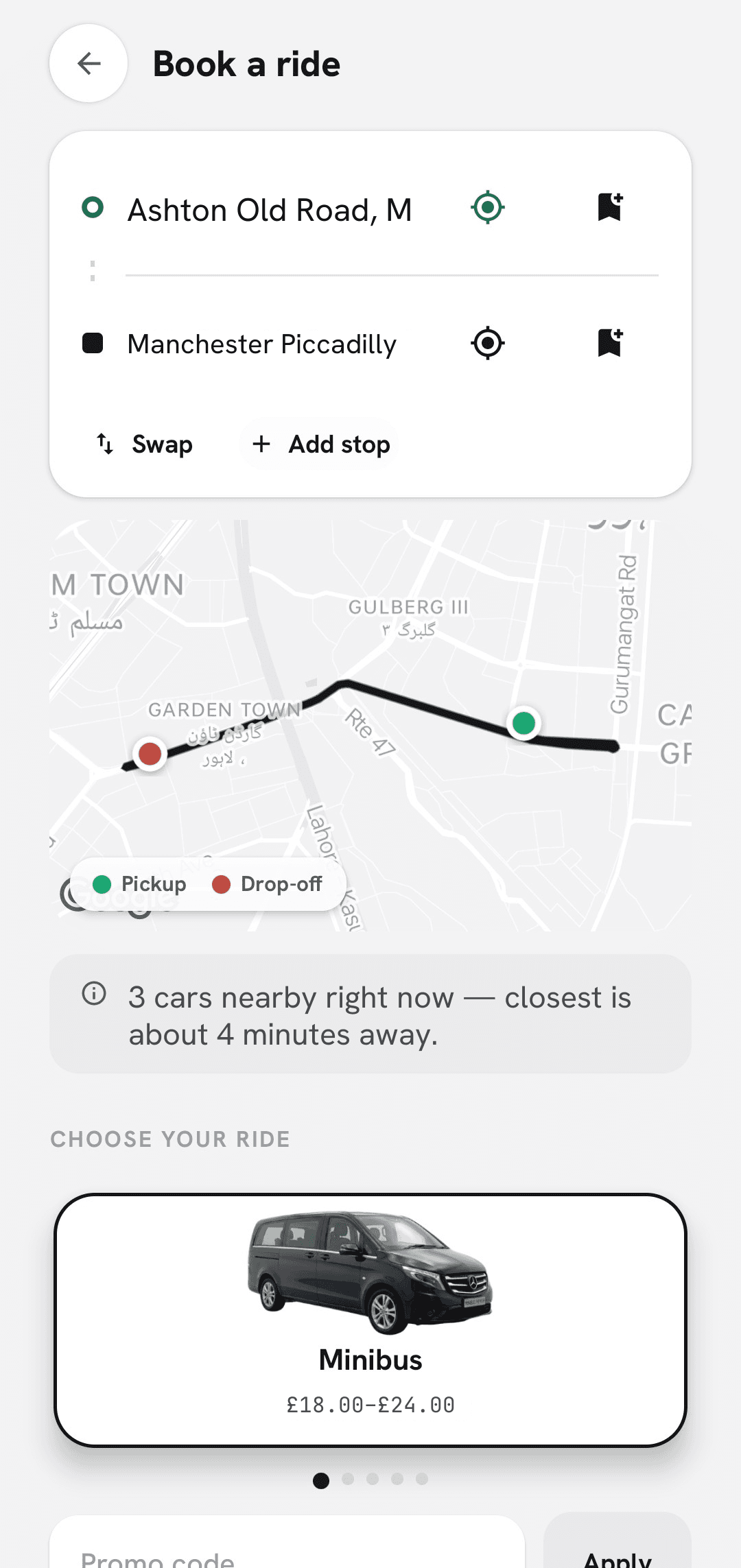
The fare is quoted from your zone tariffs, time bands and surge rules before the booking is confirmed — so the number on screen is the number they pay, and nobody rings the office to check.
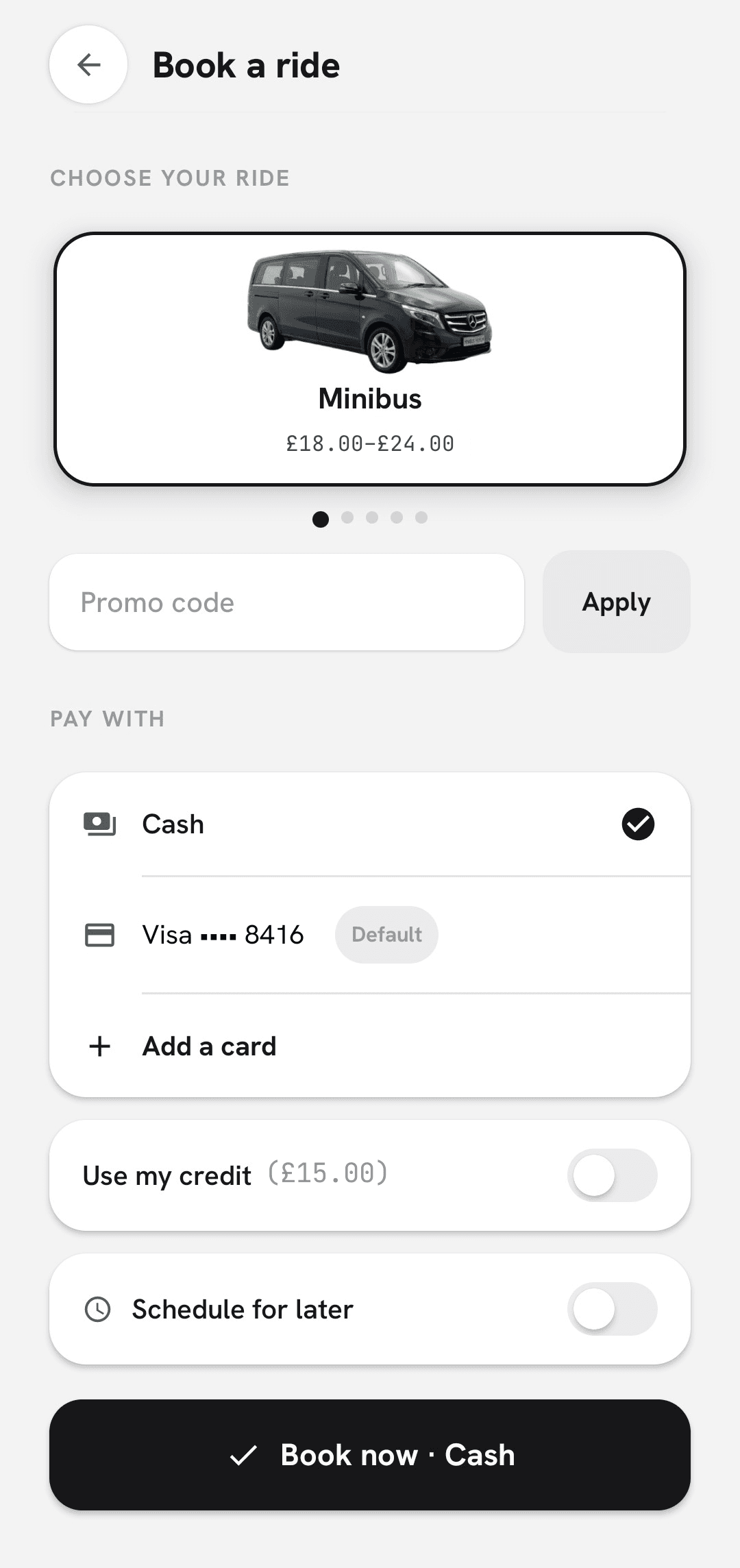
Passengers book, pay and watch the car arrive in an app that carries your brand from the first quote to the receipt — and every fare stays yours.
Passengers who would rather tap than ring are not going to start ringing again. They will book with whoever has an app, and if that is not you it is a national platform taking a slice of a fare that used to be entirely yours.
Cabica publishes a passenger booking app under your firm’s name and colours in the App Store and Google Play. It quotes from your tariffs, takes card payment into your own Stripe account, shows the passenger the assigned car moving on a map, and drops the job straight onto your dispatch board. Cabica’s name appears nowhere in it.
The four things that decide whether somebody books a second time: a price they trust, a car they can see, a payment that works, and a receipt that arrives.
The fare is quoted from your zone tariffs, time bands and surge rules before the booking is confirmed — so the number on screen is the number they pay, and nobody rings the office to check.
The assigned driver and vehicle move on the map, with a push notification when the car sets off and another on arrival. That is most of what removes “where is my taxi” from a Friday night.
Card in-app through Stripe into your account, cash on the day, or charged to a corporate account for business travellers. The passenger picks; the office does not have to chase.
Home, work and the usual airport saved after the first trip, and a previous journey rebooked in two taps. Repeat-booking friction is the difference between an app used once and an app used weekly.
Immediate pickups and scheduled journeys in the same flow — the airport run three weeks out is booked the same way as the car needed in ten minutes, and both land on the same board.
Icon, splash screen, colours, notification sender and the emailed receipt all carry your firm. The store listing sits under your developer account, so the downloads and the reviews belong to you rather than to us.
This is the calculation that decides whether a branded app is worth having, and it is usually done on the back of an envelope and got wrong.
Take the number of jobs a week you currently hand to a commission-charging platform, multiply by your average fare, and take the platform’s percentage of it. A firm doing 300 platform jobs a week at an £11 average, on a 15% rate, is paying roughly £495 a week — about £25,700 a year — for work it then does itself.
A flat subscription does not move when that number moves. That is the whole structural difference, and it is why the two models diverge sharply in exactly the situation you want to be in: growth. Commission is a tax on succeeding.
Run your own figures rather than ours. If the answer comes out smaller than a subscription, the honest conclusion is that you do not have the volume for this yet — and that is a real answer, not a reason to buy.
A booking taken on somebody else’s platform gives you a job. A booking taken in your own app gives you a customer: a phone number, an address history, a payment method on file and a push channel you can use to say the Christmas rota is open.
That difference compounds. After a year on a national platform you have completed a great many jobs and have no list. After a year on your own app you have a passenger base you can tell about a new service, remind about an airport run, or offer an account to.
A branded app published under a vendor’s developer account is a rented brand. The listing URL, the accumulated reviews, the download count and the ability to ship an update all sit with the vendor. Leaving means a new listing at zero, and asking every existing passenger to delete one app and install another.
Ask any vendor, in writing, whose developer account the app will be published under and who holds the signing keys. It is a one-line question, it is answered in a sentence, and the answer tells you most of what you need to know about the relationship.
Yes. The icon, name, colours, splash screen, push notifications and receipts are all yours, and the listing sits under your firm in the App Store and Google Play. A passenger using it has no way of knowing Cabica exists.
Yours. This is worth insisting on with any vendor, because the account holder owns the listing, its URL, its reviews and its download history. If the app is published under the vendor’s account, leaving them means starting again from zero downloads — and personally asking every existing passenger to install something new.
No. There is no per-booking fee and no percentage of the fare. You pay the monthly plan and keep the whole fare, which is the entire argument against routing your own work through a national platform.
Into your own Stripe account, directly. We are not in the payment path and we do not hold your money before passing it on — which also means Stripe’s payout schedule is yours to set rather than ours.
Branding and configuration happen during onboarding and take days. The variable is app store review, typically a few days for a first submission and occasionally longer if Apple asks a question. We handle the submission and the replies.
They book on your booking website, which quotes from the same tariffs and lands on the same dispatch board, or they ring and a controller types it in. The app is one channel of three and is not meant to replace the phone — most firms find the phone stays busy and the app is additive.
The app is one part of the booking system. The passenger app is the phone in your customer’s pocket; the booking system is that plus the booking website, the account-customer portal and the quoting rules behind all of them. If you are weighing up leaving a commission-charging platform, the booking system page is the fuller comparison.