
Revenue and Job Volume
Takings by day, week and month, split by cash, card and account, with job counts and average fare alongside. Enough to see a bad week in the week it happens rather than at month end.
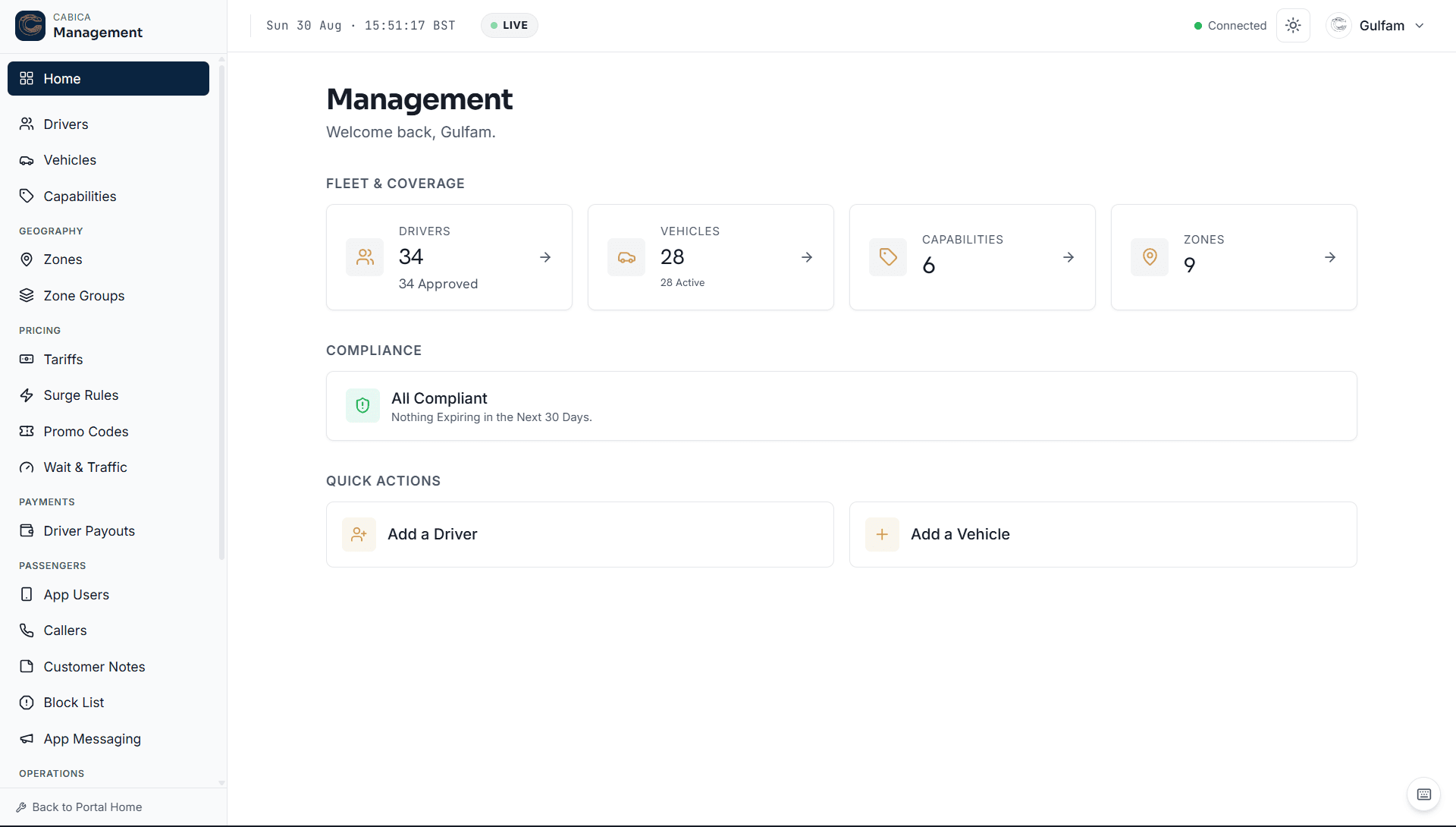
Revenue, jobs, driver performance, vehicle records and every licence expiry — worked out from the bookings that actually happened, not typed into a spreadsheet afterwards.
Most taxi firms know roughly what last week looked like. Roughly is expensive: it is why a losing account contract runs for a year, why a driver quietly stops covering their fuel, and why a licence expiry gets found by a council officer rather than by the office.
Cabica’s management dashboard is not a separate reporting product with an import step. It reads the same rows dispatch writes when a job completes, so revenue, driver settlements, account invoices and compliance status are all views of one set of facts. There is nothing to reconcile, because there is only ever one number.
Built for the half-hour on a Monday morning when somebody actually looks, rather than for a quarterly board pack nobody reads.
Takings by day, week and month, split by cash, card and account, with job counts and average fare alongside. Enough to see a bad week in the week it happens rather than at month end.
Jobs completed, offers declined, acceptance rate, cancellations, no-shows and ratings per driver. The point is not surveillance — it is finding the driver who has quietly stopped accepting the school run, before the contract is lost.
Every driver and vehicle with their documents attached: licence, badge, insurance, MOT, PHV plate, V5. One place to look when the council asks, instead of a filing cabinet and three inboxes.
Warnings ahead of every licence, insurance and MOT expiry, escalating as the date approaches, with the driver prompted in their own app to upload the replacement. Compliance stops being somebody’s memory.
What each corporate account is worth, what it costs to serve, and the month’s invoice raised from completed jobs rather than retyped. Loss-making contracts become visible instead of assumed profitable.
Where the work comes from, which zones run short of drivers and at what hours — what you need before deciding to recruit, change a tariff or reshape the rota.
Every firm that turns this on discovers roughly the same three things in the first month. None are surprises in hindsight, and all of them cost money for as long as they stay invisible.
Corporate and school contracts are won on a rate agreed at some point in the past and rarely revisited. Fuel, wages and the shape of the work all move; the rate does not.
Because every job carries its own fare, driver cost and account, the margin per contract is arithmetic rather than opinion. The usual finding is one long-standing account sitting at break-even or slightly negative once the dead mileage to reach it is counted — and it is almost never the one anybody suspected.
What to do about it is a commercial decision, not a software one. But renegotiating a rate is a conversation you can only have with a number.
Acceptance rate by driver, seen over a month, shows a pattern that is invisible day to day: the driver sitting at 60% while the fleet averages 90%, declining short town jobs and holding out for airport work.
This matters beyond fairness. The declined jobs cascade to everyone else, so the rest of the fleet absorbs the work while one person takes the value — which is precisely the resentment that ends with good drivers leaving. Seen early it is a conversation; seen late it is a walkout.
Licences, badges, insurance certificates, MOTs and PHV plates all expire on their own schedule, and the office typically tracks them on a spreadsheet updated when somebody remembers.
An expired badge is not a paperwork problem. It is an unlicensed driver carrying a passenger, an insurance position that may not respond, and a licensing authority with a legitimate question about your operator licence. Warning ahead of the date, with the driver prompted in their own app to upload the replacement, moves this from memory to process — which is the actual deliverable.
It is the layer above dispatch that turns completed jobs into information an owner can act on: revenue by period and payment type, driver and vehicle performance, account-customer profitability, and the compliance status of every licence and document. In Cabica it is not a separate product — it reads the same records dispatch writes, so there is no export and no reconciliation step.
The console is for the shift happening now — who is free, which job is late, who takes the next one. The management dashboard is for the questions that span weeks: whether takings are up, which driver has stopped accepting work, whether the hospital contract makes money, and what expires next month. Same data, different time horizon, different reader.
Yes. Documents are stored against each driver and vehicle with their expiry dates, and the system warns ahead of each one and keeps warning as it approaches. The driver is prompted in their own app to photograph and upload the replacement, so the chase does not sit with the office.
Yes — CSV on anything on the dashboard, so your accountant gets the format they want and you are not locked into reading it only in our interface. Your data leaving easily is a feature, and a vendor who makes it hard is telling you something.
Yes. Multi-branch operators get a view per base and a consolidated view across all of them, so a group can compare sites on the same measures rather than collecting three differently-shaped spreadsheets.
Real-time. A job completed ten minutes ago is in the figures, because the figures are the jobs rather than a nightly copy of them.